
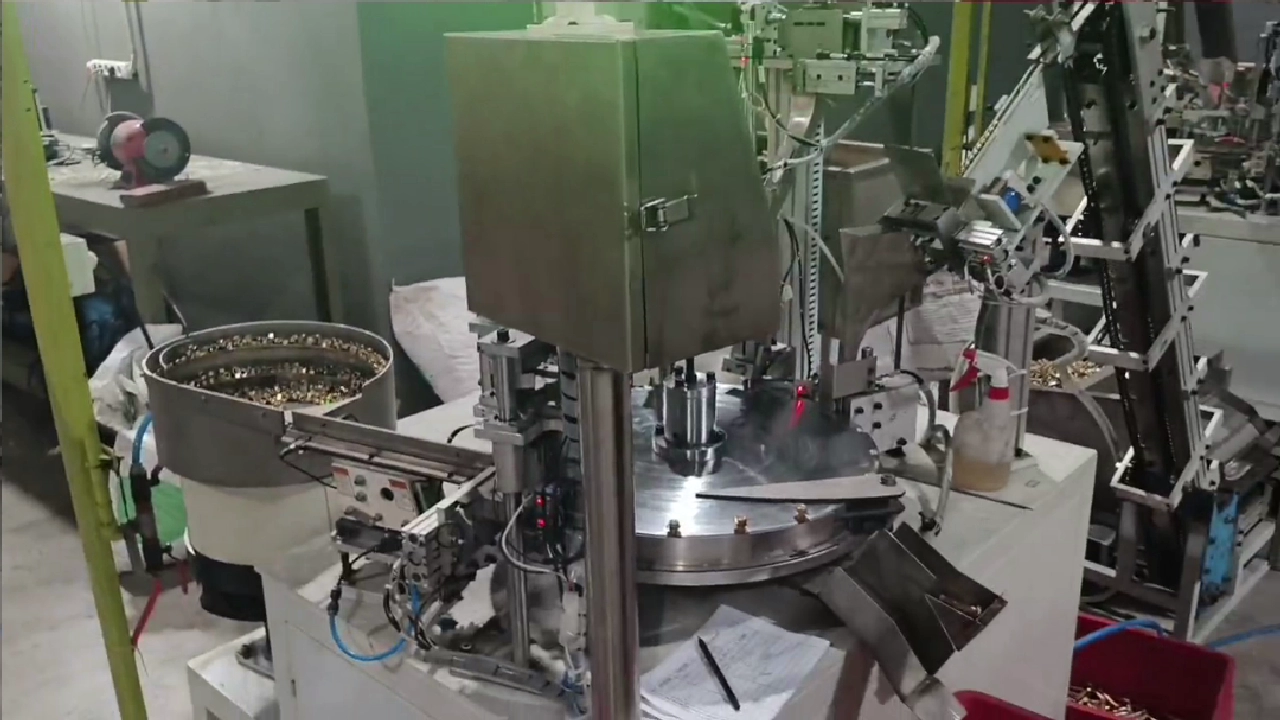
Expansion bolts consist of several small parts: the sleeve, the bolt body, the washer and the nut. Assembling them by hand is slow, inconsistent and difficult to scale. An automatic expansion bolt assembly machine replaces manual work with a fixed sequence of mechanical stations, and understanding that sequence is the best way to evaluate whether a machine fits your production.
Station 1: Vibratory feeding. Each component is loaded into a vibratory bowl feeder. The bowl uses vibration and a spiral track to separate, orient and deliver parts in a single correct posture. Bowl design is specific to each part geometry, which is why a machine is normally built around one bolt family rather than being fully universal.
Station 2: Linear transfer and orientation. Parts leave the bowl on a linear track and are checked by sensors or mechanical gauges. Any part arriving in the wrong orientation is rejected and returned to the bowl. This stage determines how stable the machine runs at high speed.
Station 3: Sleeve and bolt insertion. The sleeve is indexed into position, and the bolt body is inserted by a pneumatic or servo-driven cylinder. Insertion depth and alignment are controlled by mechanical stops, so the press force stays consistent from cycle to cycle.
Station 4: Washer and nut assembly. The washer is placed on the bolt, then the nut is fed and threaded onto the bolt end. For double-nut or double-sleeve anchors, additional stations repeat this operation with a second nut or sleeve.
Station 5: Tightening and torque control. The nut is tightened to a set torque so that every assembled bolt has the same clamping condition. Servo torque control makes it possible to record the tightening value for each cycle, which is useful for traceability.
Station 6: Inspection and discharge. Assembled bolts pass a final check that may include height measurement, thread inspection, torque verification and a visual sensor check for missing parts. Rejected bolts are diverted into a separate bin, and accepted bolts are counted and discharged.
The output of such a machine is normally expressed in pieces per minute or pieces per hour. Real throughput depends on bolt size, the number of stations, the difficulty of part feeding and how often the operator needs to refill the bowls. M6 and M8 bolts generally run faster than M12 or double-sleeve designs because the parts are smaller and easier to feed.
Foshan Zhio Equipment Co., Ltd. builds automatic assembly machines for internal and external expansion bolts, metal anchors and double-sleeve mechanical anchors, covering M6, M8, M10 and M12 sizes across several machine generations. Detailed cycle videos and factory testing are available so buyers can verify output before ordering.