
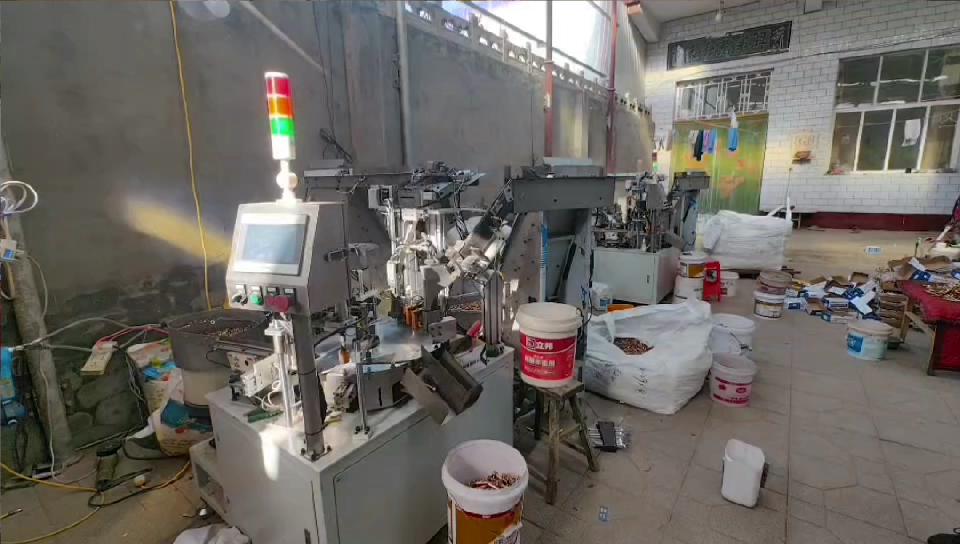
Non-standard automation projects are usually delayed at the two ends: waiting for a quotation on the front, and waiting for the site to be ready on the back. The second is entirely avoidable. This FAQ covers the installation and site-preparation questions we are asked most often, so the machine can be commissioned as soon as it arrives rather than sitting in its crate.
1. How much floor space does the machine need?
The honest answer is that the machine footprint is only part of the requirement. Plan for three areas:
- Machine footprint. Varies with the number of stations and whether loading and packing are automated. A multi-station line occupies substantially more floor than a single-station unit.
- Operator access. Working space in front of loading and inspection positions, and clear access to the service side of the machine.
- Material staging. Incoming component containers and finished-goods handling. This is the area most often forgotten, and it is the one that actually stops production when it is missing.
The practical approach is to send us your workshop layout at quotation stage. It is far easier to configure the machine around an existing space than to rearrange a workshop around a delivered machine.
2. What layout considerations matter most?
Three things drive layout more than anything else:
- Material flow direction. Components should enter and finished bolts leave without crossing the operator's working area.
- Service access. The feeding system needs regular cleaning and the stations need adjustment. If the machine is pushed against a wall, routine maintenance becomes a job nobody does.
- Future expansion. If there is any chance you will add stations or a second machine, leave the space now. Retrofitting a line into a tight corner costs more than reserving the floor area.
3. What power supply is required?
Power requirements depend on the number of stations and the drive type. As a general rule, plan for a dedicated three-phase industrial supply for the machine, sized to the total connected load with margin rather than exactly at the rated figure — startup current on pneumatic and servo stations is higher than steady-state draw. Confirm the exact voltage and phase requirement for your specific configuration against your local supply before installation, because this is one item that cannot be adjusted after the machine is built. A stable, dedicated circuit also protects the control system from interference caused by other equipment on the same line.
4. What compressed air capacity do we need?
Most automatic assembly machines use compressed air for transfer, insertion and clamping, so air supply is a genuine production dependency rather than a minor utility. Three points matter:
- Pressure stability. Fluctuating pressure causes inconsistent insertion force and intermittent faults that look electrical but are not.
- Air quality. Moisture and oil carry-over shorten pneumatic seal life significantly. A dryer and filter at the point of use is inexpensive insurance.
- Capacity margin. If the existing compressor also feeds other equipment, confirm the available flow at the machine, not at the compressor outlet.
Poor air quality is one of the most common causes of premature pneumatic failure, and it is entirely preventable at low cost.
5. Which bolt sizes can one machine handle?
The standard size range for expansion bolt assembly is M6 to M12, covering internal and external expansion bolts, wedge anchors, sleeve anchors, metal anchors and through bolts. Within that range there are two distinct configurations:
- Single-size dedicated machine. Fastest and most stable — for example a machine built specifically for M6 metal internal expansion bolts.
- Multi-size machine with changeover. Handles several sizes with interchangeable tooling, at the cost of changeover time between runs.
Sizes outside the M6–M12 band are usually possible but should be raised at specification stage, because they affect bowl tooling and station geometry rather than being a simple parameter change. It is worth noting that newer machine generations increasingly support both internal and external bolt types on a common platform, which reduces the number of machines needed for a mixed product range.
6. How many operators does an automatic line require?
This depends on the degree of automation, and it is worth being precise about what is automated:
- Automatic assembly with manual loading and unloading. Typically one operator per machine, mainly for loading components and monitoring.
- Automatic feeding, assembly and inspection. One operator can often supervise more than one machine, since their role becomes monitoring and occasional intervention rather than continuous handling.
- Fully automated line with automatic packing. Supervision-level staffing, with attention focused on incoming material and quality checks.
The production-planning consequence is that automation changes the labour profile rather than eliminating it. Where you previously had several people assembling by hand, you now need fewer people — but they need to be able to clear jams, recognise quality deviations and perform basic maintenance. That is a training requirement, not just a headcount change.
7. What should be ready before the machine arrives?
A short but critical list:
- Floor area cleared and levelled, with service access confirmed.
- Power supply installed and tested to the required specification.
- Compressed air line with dryer and filter run to the machine position.
- Incoming component stock available in production quantity — needed for the factory acceptance test.
- Operators identified and available for commissioning and training, not pulled in afterwards.
Items four and five are the ones that most often delay a productive start. A machine cannot be validated on demo parts, and training delivered weeks after commissioning has much less effect.
8. Can the machine be integrated into an existing line?
Yes, with the interfaces defined at specification stage: how components arrive, how finished bolts leave, and what signals the machine exchanges with upstream and downstream equipment. Integration is straightforward when it is designed in, and expensive when it is added afterwards. If the machine will eventually connect to packaging or inspection equipment, state that intention at the start even if the integration itself happens later.
The short version
Prepare three things before delivery: space with real service access, stable power and clean compressed air, and operators who have been assigned time for training. Confirm your bolt size range and any future integration plans at specification stage. Get those right and the machine is productive on arrival — get them wrong and a correctly built machine will still spend its first weeks waiting for the site to catch up.
For related reading, see how an automatic expansion bolt assembly machine works for the assembly sequence, internal versus external expansion bolt assembly machines for the orientation decision, and five factors that determine machine output for throughput planning.