
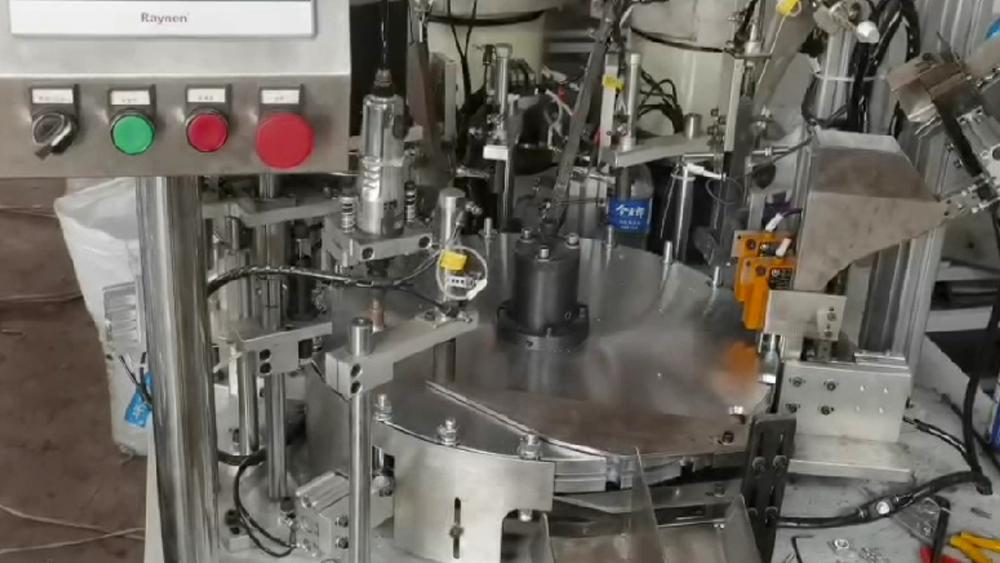
Buying an automatic expansion bolt assembly machine is not like buying a standard machine off a shelf. Almost every unit is configured around a specific bolt family, a specific output target and a specific workshop layout. That is why the buying conversation tends to follow a predictable pattern: before price, buyers want to know scope, timing and risk. Below are the twelve questions we are asked most often, with the practical answer behind each one.
1. What is the minimum order quantity?
For a fully automatic assembly machine, the minimum order quantity is normally one unit. These are not mass-produced consumer goods. A machine is built to order around your bolt specification, so the constraint is not quantity but specification clarity. That said, if you are planning to run several bolt families, it is usually more economical to confirm all of them at the quotation stage than to order a second machine later, because the second unit can then share some design work.
2. What is the typical lead time?
Bulk orders usually run 15 to 30 days from confirmed deposit and approved drawing. Two factors push that range:
- Peak season. Demand concentrates in certain quarters, and non-standard machining capacity is finite.
- Special materials. Stainless steel contact parts, hardened tooling or non-standard coatings add machining and heat-treatment steps.
A prototype or single-station unit can sometimes ship faster, but for a complete multi-station line the 15–30 day window is the realistic planning assumption. Always ask for the lead time in writing on the PI, not just in email.
3. What information do you need to quote accurately?
This is where most projects either accelerate or stall. To quote a machine that will actually run at your target rate, we need:
- Bolt drawings or physical samples. Every component matters — sleeve, bolt body, washer, nut. A single drawing of the assembled bolt is not enough, because each part is fed and oriented separately.
- Target output. Pieces per minute or per shift. This drives the number of assembly stations and the degree of automation.
- Bolt size range. For example M6 to M12. A wider range usually means changeover fixtures rather than a single fixed setup.
- Quality and inspection requirements. Whether you need in-line torque checking, presence/absence sensing or full traceability changes the control system cost.
- Workshop conditions. Available footprint, power supply and compressed air capacity.
If you only have a finished bolt, send that first. A physical sample lets us reverse-engineer the component set and give you a realistic quotation without waiting for complete drawings.
4. Can the machine run more than one bolt model?
Yes, but the honest answer is that flexibility has a cost, and it should be designed in from the start. A machine built for a single bolt family runs fastest and most stably. A machine intended for multiple models needs changeover fixtures — interchangeable bowl tooling, adjustable tracks and parameter presets in the control system. That adds engineering time and cost, and changeover itself takes time on the shop floor. If your mix is genuinely varied, it is often better to specify a modular machine than to assume one universal unit will handle everything at full speed.
5. Do you offer customization or OEM/ODM services?
Yes. Customization is based on your drawings or physical samples, and OEM/ODM service is available. Because these machines are non-standard equipment by nature, "customization" here means the whole project — feeding system, station sequence, fixture design, control logic and guarding — is specified against your part and your output target rather than selected from a catalogue.
6. How is the price actually calculated?
Price is driven by four things, roughly in this order:
- Number of stations. More assembly and inspection operations means more mechanics, actuators and control I/O.
- Degree of automation. Manual loading with automatic assembly costs less than a fully automated line with automatic feeding, inspection and packing.
- Control and inspection complexity. PLC plus HMI with basic sensing is one tier; servo-driven stations with in-line measurement and data logging is another.
- Tooling and changeover scope. One bolt family versus several models with interchangeable fixtures.
This is why a quotation without a drawing and an output target can only be an estimate. A precise figure requires a defined scope.
7. What payment terms do you accept?
Standard terms for non-standard equipment are a deposit with the balance before shipment, typically around 30% deposit and 70% before delivery. For long-standing customers, other arrangements can be discussed. Because the machine is built to your specification, the deposit covers material and machining commitment — it is not refundable on a change of mind after production starts.
8. Which Incoterms and shipping ports do you support?
We support the common Incoterms — EXW, FOB, CIF and DDP — depending on how much of the logistics chain you want us to handle. Main shipping ports are Shanghai, Ningbo and Shenzhen. For machines, sea freight is the normal choice; air freight is usually reserved for urgent spare parts because of the weight and volume involved.
9. Do you have stock? Is delivery on time?
Some regular models of assembly machine and common spare parts are kept in stock. Complete custom machines are built to order, so they are not held as inventory. We do follow committed lead times — but the practical advice is to build a buffer into your own production plan, particularly for the first unit of a new design, because commissioning and operator training happen after the machine arrives.
10. What is included beyond the machine itself?
A normal delivery includes the machine, the standard tooling for the agreed bolt specification, documentation, and commissioning support. The specific scope — whether on-site installation is included, how many days of training, and what spare parts ship with the unit — should be written into the contract. Ask explicitly about spare parts; having a small set of the wear items on hand avoids a stoppage waiting for a shipment.
11. How do we validate the machine before full production?
The practical route is a factory acceptance test on your own parts, not on demo parts. Send a production-quantity sample of each component and confirm three things during the test: assembly consistency, actual output rate against your target, and reject behaviour when a defective component is introduced. A machine that achieves the rated speed on ideal parts but jams on your real parts is not yet validated.
12. What after-sales support is available?
Support normally covers commissioning, operator training, documentation handover and ongoing technical assistance for troubleshooting and future orders. For export customers, remote support with video and documented procedures handles the majority of issues without a site visit. What matters for planning is to confirm the response channel and the spare parts availability up front, because the machine's real cost of ownership is determined by downtime, not by purchase price alone.
The short version
If you summarise this list into a single piece of advice: the quality of the input determines the quality of the quotation. Send component drawings or samples, a target output, and a bolt size range. With those three things, MOQ, lead time, price and configuration all become concrete numbers instead of estimates — and the 15–30 day lead time starts from a confirmed design rather than from a series of clarifying emails.
For a walkthrough of how the assembly sequence itself works, see our guide on how an automatic expansion bolt assembly machine works. If you are still deciding on machine orientation, the comparison of internal versus external expansion bolt assembly machines covers that decision, and five factors that determine machine output explains what actually limits your throughput.